Authentication is the backbone of cybersecurity. As threats evolve, organizations are moving beyond passwords to stronger methods like passkeys and two-factor authentication (2FA). Both aim to protect identities and sensitive data, but they do so in different ways. Understanding these differences, and where they complement each other, can help you build a more resilient security strategy.
Key takeaways:
What Is a Passkey?
Passkeys are a passwordless authentication method based on public-key cryptography. Instead of storing a shared secret like a password, passkeys use a pair of cryptographic keys—one public, one private. The private key stays on the user’s device, while the public key is stored by the service. Passkey authentication happens through a secure challenge-response process, often combined with biometrics or device PINs.
Why it matters:
- Phishing-resistant: Passkeys cannot be intercepted or reused because they never leave the device.
- User-friendly: No need to remember complex passwords or worry about password reuse.
- Device-bound: Typically tied to a user’s smartphone or hardware token, adding physical security.
What Is Two-Factor Authentication (2FA)?
Two-factor authentication (2FA) is actually a subset of multi-factor authentication (MFA). While MFA refers to using two or more factors for identity verification, two-factor authentication is a security process that requires users to provide only two distinct forms of identification before granting access. These factors typically fall into different categories:
- Something you know – such as a password or PIN.
- Something you have – like a one-time code delivered via SMS, an authenticator app, or a physical security token.
By combining these two factors, 2FA significantly reduces the likelihood of unauthorized access. Even if a password is stolen or guessed, attackers still need the second factor to complete the login process.
Why organizations use 2FA:
- Enhanced security for legacy systems: Many businesses still rely on password-based authentication, and 2FA adds a critical layer without requiring a full infrastructure overhaul.
- Compliance alignment: Regulatory frameworks like PCI-DSS, HIPAA, and GDPR often mandate multi-factor authentication for sensitive data access.
- Versatility: 2FA can be implemented across web applications, VPNs, and physical access systems, making it a flexible solution for diverse environments.
While 2FA improves security, it’s not foolproof. SMS-based codes can be intercepted, and phishing attacks can trick users into revealing both factors. Additionally, because 2FA still relies on passwords as the first factor, it inherits the weaknesses of password-based systems, such as reuse and poor complexity.
Passkey vs 2FA: Key Differences
| Feature |
Passkey |
2FA |
| Passwordless |
Yes |
No |
| Phishing Resistant |
High |
Moderate |
| User Experience |
Seamless |
Requires extra step |
| Compliance Support |
Strong for zero trust |
Strong for MFA mandates |
Passkeys represent a leap forward in usability and security, while 2FA remains a practical enhancement for legacy systems. Organizations often start with 2FA and transition to passkeys as part of a broader passwordless strategy.
Passkey vs 2FA Overlap & How to Choose the Right Approach
Stolen credentials were the initial access vector in 22% of data breaches in 2025, highlighting why stronger authentication methods like passkeys and 2FA are critical for business security.1 Passkeys and 2FA share the same ultimate goal: strengthening authentication and reducing reliance on vulnerable passwords. Both methods align with zero trust principles and help organizations meet compliance requirements like HIPAA, PCI-DSS, and GDPR. They also serve as critical safeguards against credential-based attacks, making them essential components of a layered security strategy.
Choosing the right approach depends on your organization’s needs and timeline:
- Short-term improvements: If you need a quick security boost without major infrastructure changes, 2FA is a practical starting point. It’s widely supported and easy to deploy across existing systems.
- Long-term strategy: Passkeys represent the future of authentication. By eliminating passwords entirely, they deliver phishing resistance and a seamless user experience. Transitioning to passkeys supports zero trust initiatives and positions your organization for a passwordless future.
- Best practice: Consider a hybrid approach. Use passkeys for primary logins where possible and apply 2FA for high-risk transactions or legacy systems. This layered model maximizes security while accommodating operational realities.
Future-Proof Your Authentication Strategy with rf IDEAS
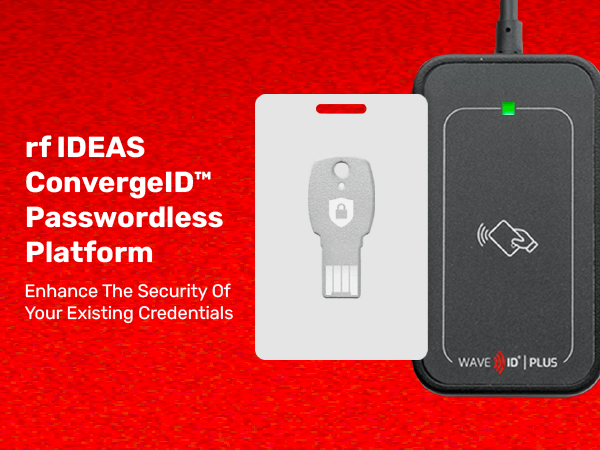
As businesses embrace passwordless technologies, rf IDEAS provides secure credential readers and solutions that integrate with passkey-based systems and MFA frameworks. Whether you’re upgrading from legacy credentials or building a zero trust architecture, we help you stay ahead of evolving threats.
Contact us to explore solutions that fit your authentication strategy.