Mobile credentials have quickly become the new norm across higher education. Students expect digital-first access experiences, IT teams prioritize mobile-enabled security practices, and institutions increasingly view mobile credentials as integral to their brand identity. But even as adoption increases, mobile credential usage on most campuses remains limited to door access, leaving significant value untapped.
The future of campus access control goes far beyond unlocking buildings. It’s about creating a flexible, scalable access ecosystem that allows mobile credentials to be used consistently and securely across every environment where students, faculty, and staff interact. Below, we explore how higher ed institutions can bridge the gap between mobile credentials and full campus enablement.
Key takeaways:
Mobile Credentials Are Now An Expectation
Mobile credentials have moved well beyond the “innovation” phase and are now a defining expectation of a modern higher education environment. Students want secure, intuitive, app-like mobility throughout their day, whether they are entering dining facilities, checking into campus events, accessing recreation centers, or authenticating at shared kiosks. When campus access control systems don’t support these experiences, the inconsistency becomes noticeable.
Institutions also feel the pressure. Mobile-first access increasingly reflects a school’s commitment to modernization, operational confidence, and student-centered design. Additionally, cybersecurity pressure on higher education has never been higher. In June of last year, a targeted attack compromised 2.5 million Columbia University application records, exposing applicant data and causing an outage that shut down email and other digital operations for days.¹ This breach underscored the need for consistent, phishing‑resistant authentication on the systems behind admissions, financial aid, and academic operations. Extending mobile credentials to fixed workstations—for example, student logins in computer labs and library stations, or staff logins in financial aid, registrar, and research offices—creates a single, stronger identity signal across facilities and desktops. That consistency hardens day‑to‑day workflows and supports faster containment and recovery when attacks occur.
Despite such incidents, many campuses find that simply issuing mobile credentials does not change much if the systems behind them can’t support their use outside of core building access points. To deliver the experience students expect, universities must look beyond the credential itself and evaluate how their access infrastructure can support broader, more flexible enablement.
The Hidden Gap Between Credential and Campus
Even when mobile credentials are deployed, many campus access control systems still rely on outdated or incompatible hardware in key areas of student life. A student may use a mobile ID to unlock a residence hall door, but still swipe a magstripe card to enter the recreation center, manually check in for an advising appointment, or wait in line to authenticate for a campus event. These inconsistencies create daily friction that can undermine the value and perception of the institution’s investment.
This gap is rarely intentional. Rather, it results from legacy systems, departmental silos, and authentication technologies that were never designed to support modern mobile experiences. Over time, these fragmented processes make the entire campus feel disjointed, and the promise of seamless mobility never fully materializes.
The Key to Scaling Mobile Credentials Across Campus
Higher education environments are uniquely complex. Departments operate semi‑independently, each with its own systems, vendors, and priorities. This creates fragmented campus access control systems that cannot uniformly support mobile credentials.
Common challenges include:
- Mixed vendor ecosystems
- Legacy hardware unable to read mobile wallets
- Inconsistent compatibility across Apple Wallet, Google Wallet, and campus apps
- Security leaders requiring stronger identity assurance
- IT teams needing to reduce technical debt, not add more
Campuses want mobile-first access. Their infrastructure simply hasn’t been designed to support it across all environments until recently. The urgency behind modernizing identity infrastructure becomes even clearer when looking at the threat landscape. The education sector now faces an average of 4,356 cyber threats per week, making it one of the most frequently targeted industries globally. For many institutions, the question is no longer if an attack will occur, but when.²
Institutions that succeed in scaling mobile credentials typically focus on solutions that integrate smoothly with existing systems, accommodate multiple wallet and credential types, and create consistency across campus without requiring major disruption. With a flexible, partner‑agnostic approach, universities can extend mobile access at their own pace while continuing to meet the unique needs of each department and service area.
Logical Access Across the Entire Campus
When flexible infrastructure is in place, the campus environment transforms. Students can move more naturally throughout their day, using their mobile credentials not just at residence halls or academic buildings, but at every moment throughout their day on campus. Faculty and staff benefit as well, with streamlined access to training systems, administrative environments, research labs, and workplace applications.
This kind of expansion improves the campus experience, strengthens security through consistent authentication practices, and reduces manual processes that often slow down operations. It also allows institutions to reinforce their reputation for innovation and digital readiness in ways that students and staff can immediately feel. Whether a student is tapping in at a campus facility or accessing services at a kiosk, rf IDEAS helps ensure the interaction feels the same everywhere, reinforcing a unified security posture.
Why Partner‑Agnostic Enablement Matters
Partner‑agnostic enablement ensures that mobile credentials integrate cleanly with the institution’s existing investments while supporting phased deployment and future growth.
This approach offers clear advantages to every stakeholder group.
Security & IAM / IT Leaders
- Reduce identity risk
- Lower technical debt
- Preserve credential choice (today and tomorrow)
- Maintain access consistency across departments
Auxiliary Services
- Deliver smoother mobile-first experiences
- Improve service throughput
- Reduce exceptions and manual processes
Procurement & Governance
- Protect existing investments
- Support phased deployment
- Ensure compatibility across diverse campus platforms
A partner‑agnostic approach ensures that campus access control evolves as technology and student expectations change.
The Future of Campus Access Control Is Flexible and Mobile‑First
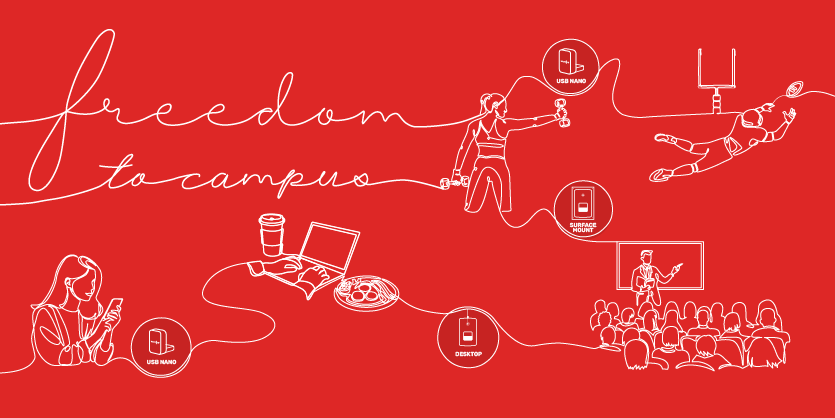
Higher education institutions do not need to immediately rebuild their infrastructure to modernize access. By extending mobile credentials across flexible and interoperable campus access control systems in a phased approach, they can unlock significant value and truly realize the freedom to campus.
Freedom to campus is improving security, supporting operational efficiency, and delivering the seamless digital‑first experiences students now expect.
Mobile credentials were only the beginning. The real transformation occurs when the entire campus is enabled to use them.